

Beyond the Pane: Choosing Window Glass for Modern Homes
Key Takeaways
- Hot climates (e.g., Rajasthan): specify SHGC ≤ 0.25–0.35 with spectrally selective solar-control Low-E glass; cold climates: prioritise U ≤ 1.0–1.4 W/m²·K with triple/argon glazing and high SHGC on sun-facing sides.
- Double glazing (DGU) is the minimum standard for any quality residence; single glazing is only for unconditioned spaces.
- Safety glass is non-negotiable in doors, low windows, bathrooms, and stairs — tempered for impact, laminated overhead and for security.
- Near roads, aim for Rw + Ctr ≥ 40 dB using asymmetric laminated DGU with acoustic PVB — and casement (not sliding) frames with airtight seals.
- Orientation and external shading beat any coating — shade east and west glass with fins, verandahs, and chhajjas first.
- Always demand certified whole-window data (Uw, SHGC, VLT, STC/Rw test reports) — not brochure claims.
An article for Architects, Interior Designers & Homeowners — From the Deserts of Rajasthan to the Snow Belts of the World
1. Why Glass Selection Deserves More Attention Than It Gets
1.
Why Glass Selection Deserves More Attention Than It Gets
Glass is one of the most versatile
materials in residential design. It dissolves boundaries between indoors and
outdoors, makes compact rooms feel expansive, borrows daylight deep into floor
plates, and gives a home its contemporary character. But glass is also the weakest
thermal link in the building envelope, a potential safety hazard, an
acoustic leak, and — if chosen poorly — a source of glare, fading
furniture, and punishing energy bills.
The plain panes in older homes and
the high-performance glazing in modern ones may look identical, but they are
fundamentally different products. Today's architectural glass is engineered:
coated at the atomic level, laminated with acoustic polymers, filled with inert
gases, and heat-treated to be four to five times stronger than ordinary glass.
Selecting it well means understanding a small set of performance metrics, a
menu of glass types, and how your climate, site, and lifestyle rank them.
This guide brings together best
practices from leading global glass manufacturers — AIS (Asahi India Glass),
Saint-Gobain, Guardian Glass, Pilkington/NSG, Vitro, and Cardinal — into a
single, climate-aware reference you can specify from.
2.
The Five Numbers That Decide Everything
Before choosing a type of glass, learn the vocabulary of
performance. Every reputable manufacturer publishes these values; insist on
seeing them.
2.1
Visible Light Transmittance (VLT %)
- What it is: The percentage of visible light that passes through the glass. A VLT of 70% means 70% of daylight enters; the rest is reflected or absorbed.
- Why it matters: Higher VLT = brighter interiors and lower artificial lighting loads, but potentially more glare and heat. Lower VLT = better glare control and privacy, but dimmer rooms.
- Rule of thumb: For living spaces, aim for VLT above 50–60% so rooms stay cheerful without blinds being drawn all day. In general, glass visible transmittance above 70% is preferred where daylighting is a design goal. India's ECBC sets a minimum VLT of 0.27 for fenestration, ensuring daylight is never fully sacrificed for heat control.
2.2
U-Factor (U-Value)
- What it is: The rate of heat transfer through the glazing due to temperature difference between inside and outside, measured in W/m²·K (or Btu/h·ft²·°F). Lower = better insulation.
- Why it matters: In cold climates, a low U-factor keeps expensive heat indoors. In hot climates, it reduces conducted heat gain — the 45°C desert air pushing warmth through the glass even at night.
- Typical values: Single clear glass ≈ 5.8 W/m²·K; standard double glazing ≈ 2.7–2.9; double glazing with Low-E and argon ≈ 1.1–1.5; triple glazing can reach ≈ 0.7–1.0 W/m²·K.
- Pro tip: Always ask for the whole-window U-value (Uw), not the centre-of-glass value (Ug). Centre-of-glass numbers can be 10–40% better than the assembled product with frame and spacers included. Frames matter: thermally broken aluminium or uPVC/timber frames prevent the frame itself from becoming a thermal bridge.
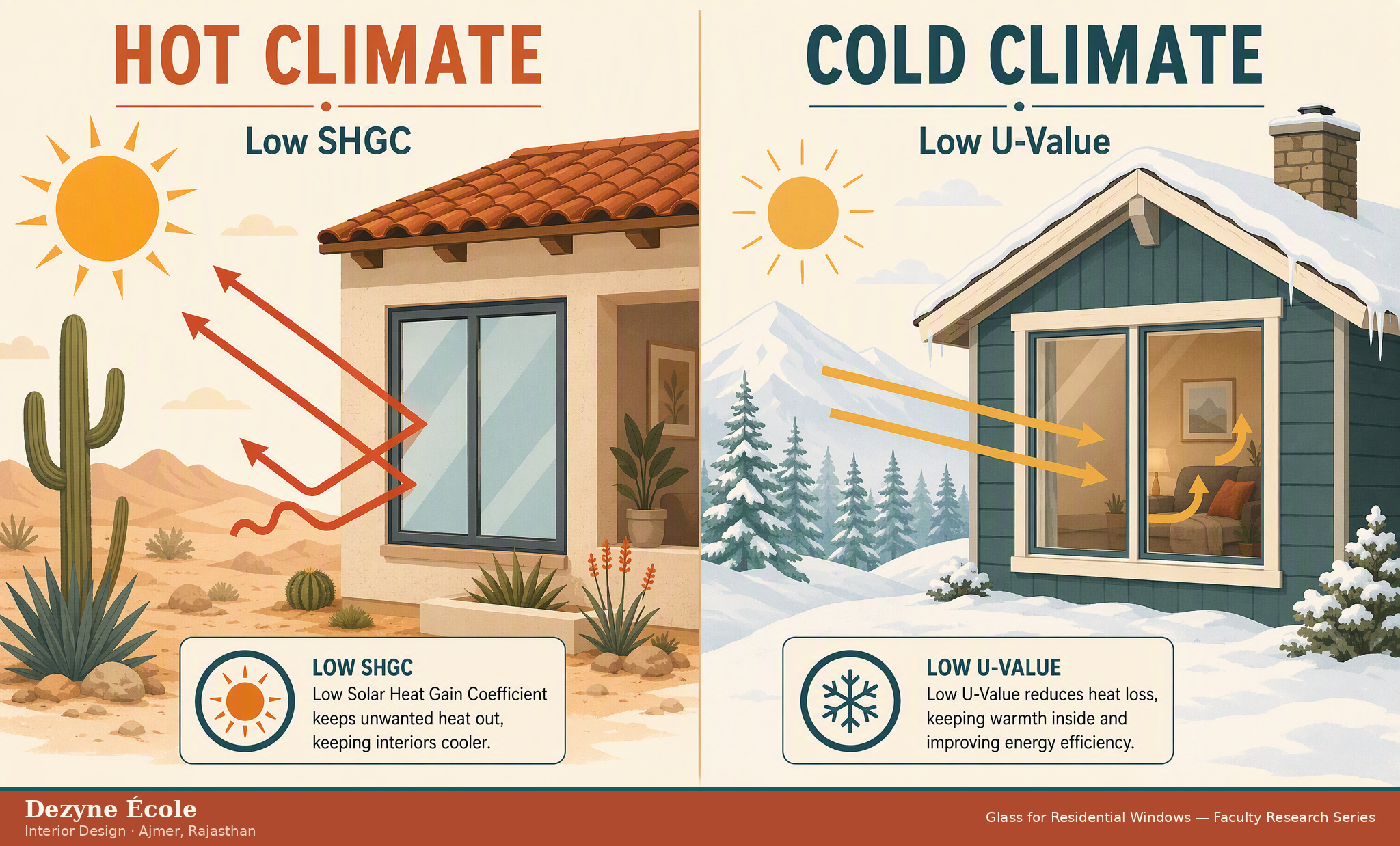 Hot climate vs cold climate window glass selection: Low SHGC vs Low U-Value infographic
2.3
Solar Heat Gain Coefficient (SHGC / g-value)
- What it is: The fraction of solar radiation that enters through the glass as heat, on a scale of 0 to 1. SHGC 0.25 means only 25% of the sun's heat gets in — 75% is blocked.
- Why it matters: This is the single most important number in hot climates. In cooling-dominated regions, a window with SHGC 0.25 versus 0.50 can cut cooling energy demand by 15–30% on a sun-exposed façade.
- Climate logic:
- Hot climates (Rajasthan, Texas, UAE, Queensland): SHGC ≤ 0.25–0.40 across all orientations.
- Cold climates (Canada, Scandinavia, the Himalayas): Moderate-to-high SHGC (0.40–0.62) on equator-facing windows for free passive solar heating in winter; low SHGC on east/west to block low-angle summer sun.
- India's ECBC 2017 caps vertical fenestration SHGC at 0.27 (non-north) for its hot-and-dry and composite climate zones, and allows 0.62 in cold zones — a neat illustration of the same principle.
2.4
Emissivity & Low-E Coatings
- What it is: Emissivity measures how readily a surface radiates heat. Ordinary glass has high emissivity (~0.84); a Low-E (low-emissivity) coating — a microscopically thin, invisible layer of metal or metallic oxide — drops it dramatically, reflecting long-wave infrared (heat) while admitting visible light.
- Two families:
- Hard coat (pyrolytic): Baked onto the glass during manufacture; extremely durable, can be heat-treated and curved; slightly lower performance.
- Soft coat (sputtered): Applied in vacuum chambers; superior thermal and solar performance (double- and triple-silver coatings), but must live inside a sealed double-glazed unit.
- Why it matters: Low-E glass lets light in but keeps radiant heat out (or in, depending on climate and coating placement). It also blocks most UV — protecting occupants and preventing fabrics, art, and wooden floors from fading. Laminated glass interlayers similarly filter up to 99% of UV rays.
- Spectrally selective glass is the premium version: engineered for a high VLT-to-SHGC ratio, so you get bright, neutral daylight with very low heat gain — the ideal for hot climates where dark tints would otherwise be the only option.
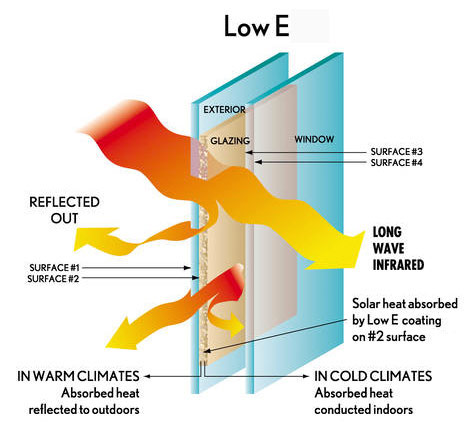 Low-E in warm vs. cold climates (474×429 px — lower res — uniquely shows coating placement logic for both climates
2.5
Acoustic Ratings: STC, Rw, and OITC
- STC (Sound Transmission Class): The North American single-number rating for how well a partition blocks sound; best for interior-type noise like speech and TV. Rw is the near-equivalent European index; the two track within 1–2 points.
- Rw + Ctr: Rw corrected for low-frequency sound — the rumble of traffic, trains, and aircraft. If your house is near a road, this is the number to check.
- OITC (Outdoor-Indoor Transmission Class): Calculated over 80–5000 Hz specifically for exterior noise sources; recommended for rating façade glazing.
- Reference points: A single 6 mm pane sits around STC 31; standard residential walls are about STC 33; genuinely quiet interiors near traffic need glazing in the STC/Rw 40–45+ range. Doubling the glass does not double the rating — two 6 mm panes only reach ~36, which is why construction strategy matters more than thickness alone (see Section 6).
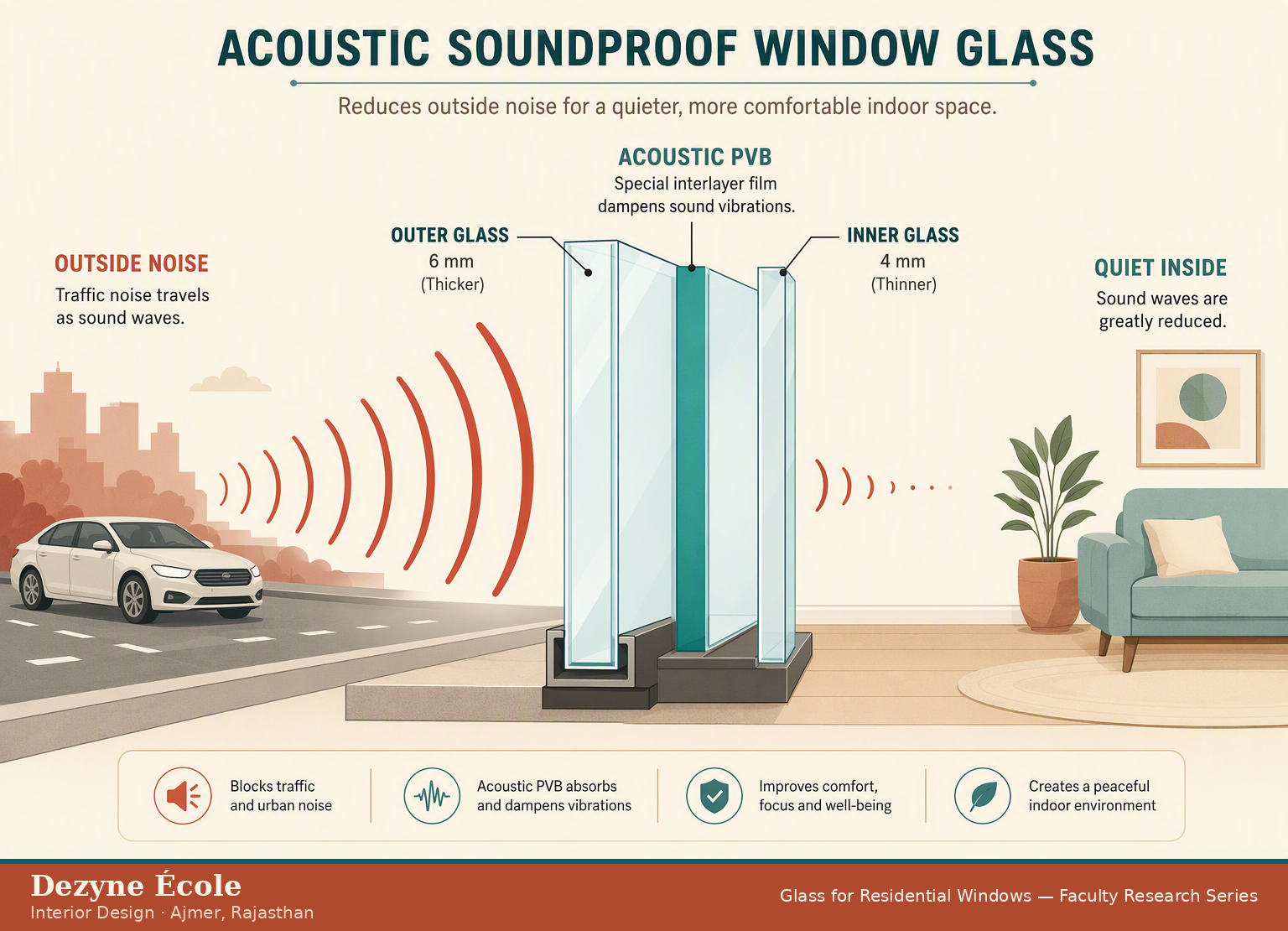 Acoustic laminated glass window diagram reducing traffic noise with PVB interlayer
Quick-Reference
Metric Table
| Metric | What it controls | Hot climate (e.g., Rajasthan) | Cold/snowy climate |
| VLT | Daylight, glare | 40–60% (balance light vs. heat) | As high as possible (70%+) |
| U-factor | Conducted heat flow | ≤ 1.8–2.0 W/m²·K (DGU + thermally broken frame) | ≤ 1.0–1.4 W/m²·K (triple/DGU + argon) |
| SHGC | Solar heat gain | ≤ 0.25–0.35 | 0.40–0.62 south-facing; low on E/W |
| UV block | Fading, health | 95–99% (Low-E/laminated) | 95–99% |
| STC / Rw+Ctr | Noise | 40+ near roads (check Rw+Ctr) | 40+ near roads |
3.
Glazing Configurations: Single, Double, and Triple
3.1
Single Glazing
One sheet of glass in a frame. It is
the cheapest option and — thermally and acoustically — barely better than an
open hole. Single glazing is acceptable only in mild, temperate zones for
unconditioned spaces, or where budget is absolutely constrained. In a 45–50°C
Rajasthan summer or a sub-zero winter, it guarantees discomfort and high energy
bills, plus heavy condensation in cold weather.
3.2
Double Glazing (DGU / IGU — Insulated Glass Unit)
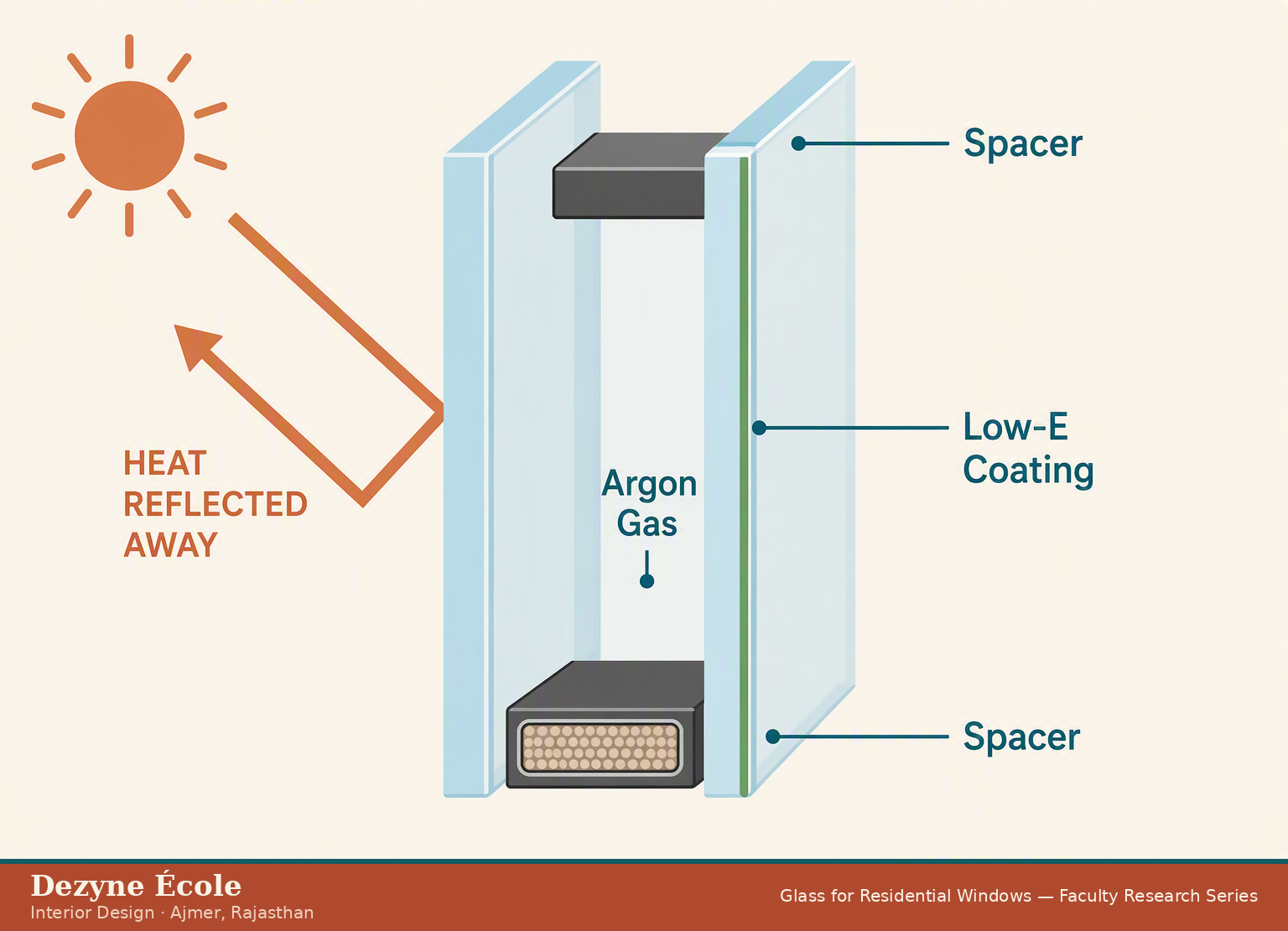
Two panes separated by a sealed
cavity (typically 12–16 mm) filled with air or argon, held apart by a spacer
and hermetically sealed. This is the default standard for quality residences
worldwide, delivering:
- Reduced heat ingress in summer and heat loss in winter
- Elimination of interior condensation in most conditions
- Meaningful noise reduction
- A protected cavity to house soft-coat Low-E and solar-control coatings
Upgrades worth specifying:
- Argon fill (or krypton in slim cavities) improves the U-value by roughly 10–15% for a modest cost premium.
- Warm-edge spacers (insulating polymer/stainless instead of aluminium) reduce edge-of-glass heat loss and the condensation ring that forms around the perimeter in winter — worth it in every climate.
- Asymmetric thickness (e.g., 6 mm outer + 4 mm inner, or thicker) to improve acoustics by detuning resonance (Section 6).
3.3
Triple Glazing
Three panes, two cavities. Standard
in Scandinavia, Canada, and passive-house construction, it can reach U-values
near 0.7 W/m²·K with argon and dual Low-E coatings. Specify it for cold and
snowy climates, extreme acoustic demands, or near-zero-energy projects. The
trade-offs: cost, weight (heavier hardware and frames), and slightly reduced
light transmission (typically ~64–73% vs ~79–81% for double). In hot climates,
triple glazing usually offers diminishing returns versus a good solar-control
double unit — spend the money on a lower SHGC instead.
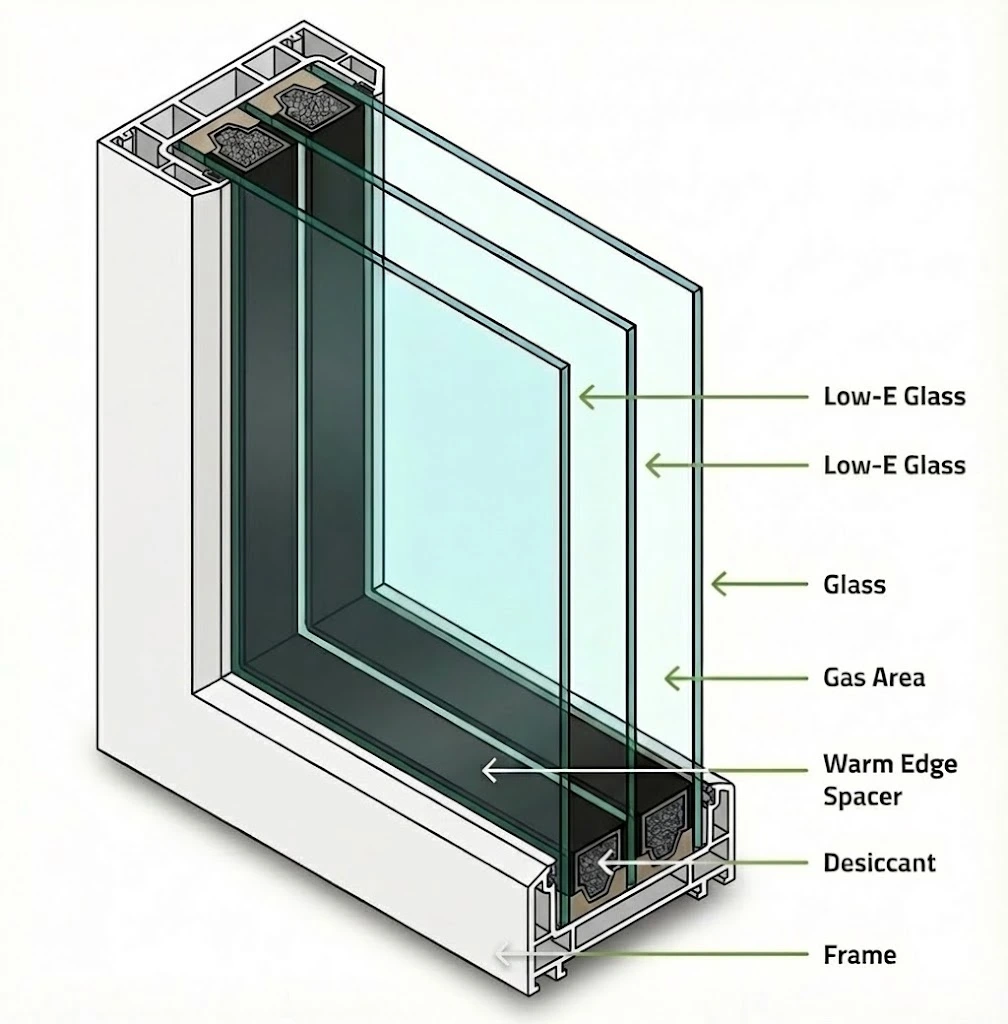 Triple-glazed window with Low-E, gas fill, warm-edge spacer, desiccant (1008×1024 px)
4.
The Glass Types, Explained One by One
4.1
Annealed (Float) Glass
The base product from the float line
— clear, flat, and untreated. When it breaks, it shatters into large, sharp
shards. It is not a safety glass and should not be used where human
impact is possible (doors, low windows, bathrooms) without a safety film or
lamination. Most processed glass starts as annealed float glass.
4.2
Tempered (Toughened) Glass
Annealed glass reheated to ~620°C
and rapidly cooled, locking the surface in compression. The result:
- 4–5 times stronger than annealed glass against impact and wind load
- Better resistance to thermal stress (important where one part of the pane bakes in the sun and another sits in shade)
- Breaks into small, blunt granules instead of lethal shards — a true safety glass
Uses: Doors, shower enclosures, table tops, facades, low-level
glazing, skylights. Note: tempered glass cannot be cut or drilled after
toughening — all fabrication happens first. Rare spontaneous breakage from
nickel-sulphide inclusions can be virtually eliminated by specifying heat-soak-tested
(HST) tempered glass for critical, hard-to-access locations (overhead,
frameless, high-rise).
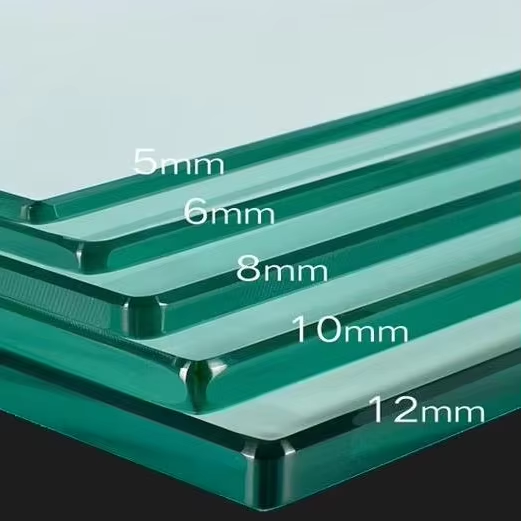 Tempered glass thickness comparison (521×521 px) — thickness choices (5–12 mm).
4.3
Heat-Strengthened Glass
Same process, gentler quench: about
twice as strong as annealed, with better thermal-stress resistance, but it
breaks into larger fragments and is not classed as a safety glass on its
own. Its real role is as the component plies of laminated or coated units where
thermal stress is a concern (e.g., behind spandrels, or tinted/reflective glass
in hot sun).
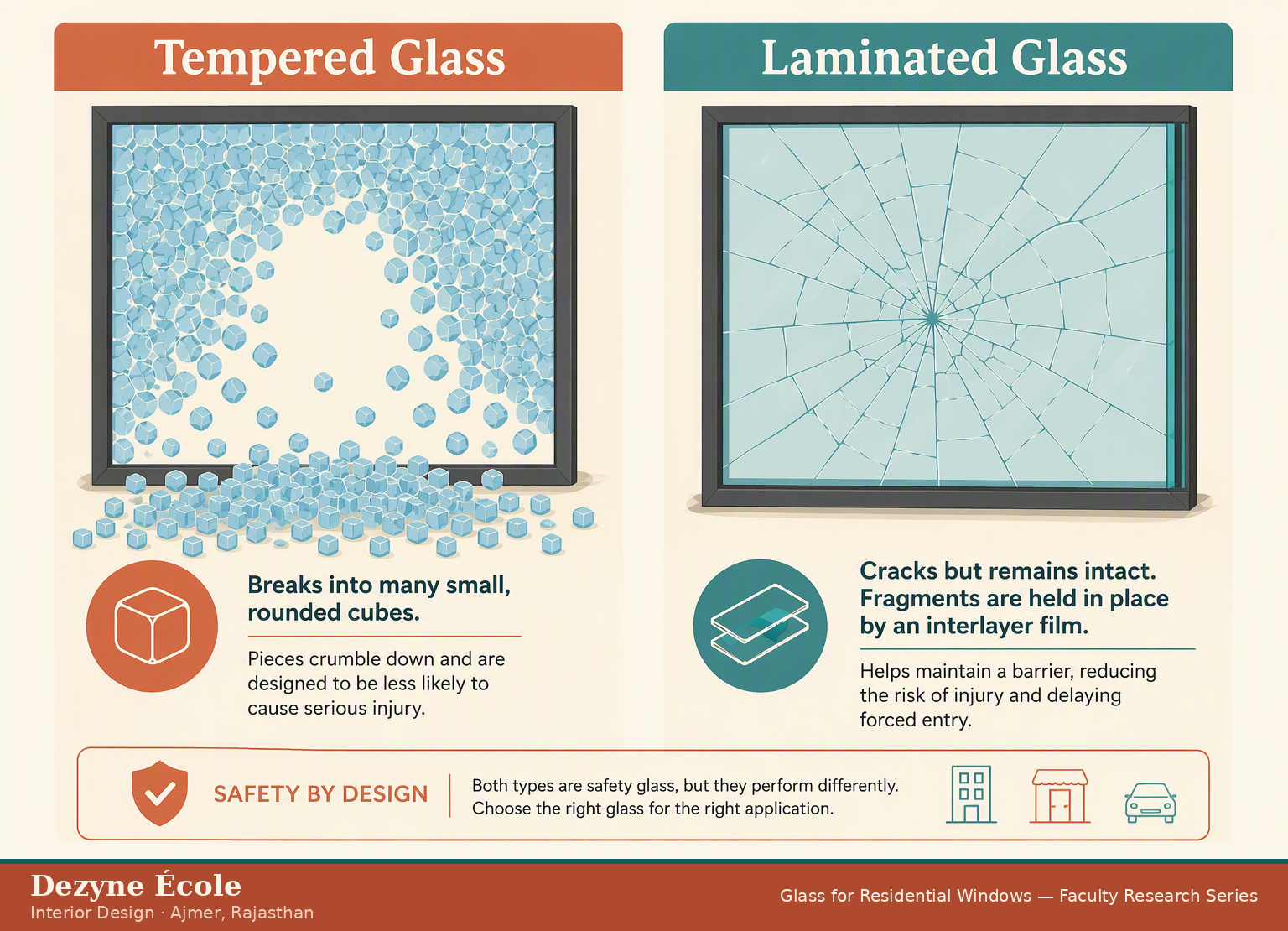 Tempered glass vs laminated glass breakage behaviour comparison infographic
4.4
Laminated Glass
Two or more glass sheets bonded
under heat and pressure to a PVB (polyvinyl butyral) interlayer — the
technology in every car windscreen.
- Safety: If broken, fragments stick to the interlayer; the pane stays in the frame, eliminating falling shards and cut injuries. Ideal where children are around.
- Security: Extremely intrusion-resistant — even when cracked, the membrane is very hard to penetrate. Thicker or multiple interlayers (and ionoplast/SentryGlas-type interlayers) escalate it to forced-entry, hurricane, and blast resistance.
- Acoustics: The viscoelastic interlayer damps vibration, giving laminated glass measurably better sound insulation than monolithic glass of the same thickness — and special acoustic PVB interlayers push this further.
- UV: Filters up to 99% of UV, protecting interiors from fading.
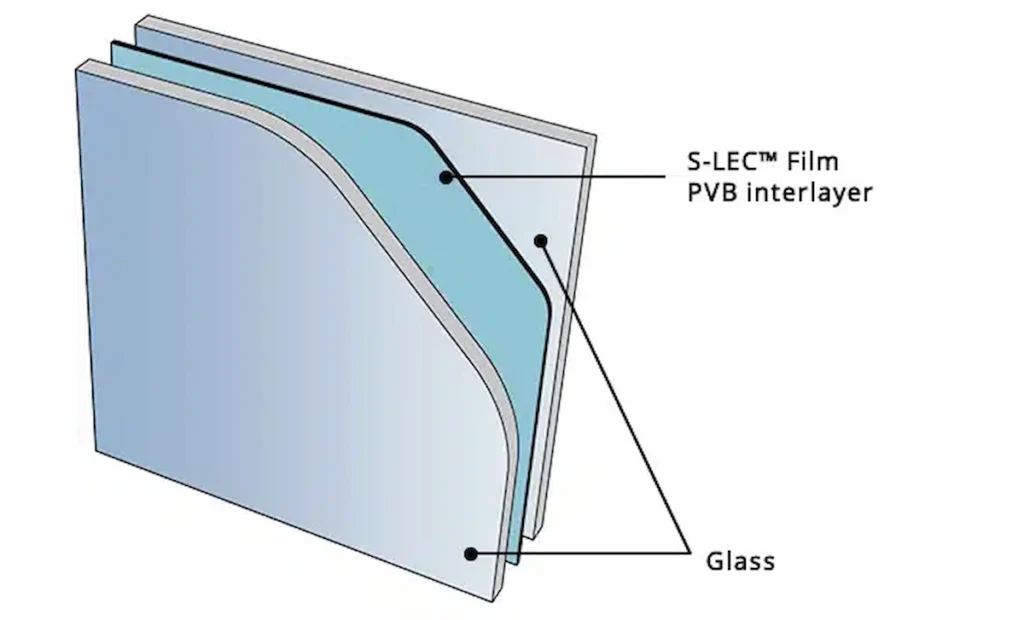 Glass + PVB interlayer sandwich diagram (1024×620 px)
 Uses: Windows and doors (security + safety + acoustics in one),
skylights and overhead glazing (mandatory logic: nothing should rain shards),
railings and balustrades, glass floors and staircases, canopies. A tempered-laminated
build-up combines the strength of tempering with the retention of lamination —
the gold standard for structural and overhead applications.
4.5
Tinted (Body-Tinted) Glass
Metal oxides in the melt give
bronze, grey, green, or blue tints that absorb solar energy — typically cutting
30–45% of solar heat — while muting glare. Limitations: absorbed heat
re-radiates partly inward, tints reduce VLT (darker rooms), and heat absorption
raises thermal-stress risk, often requiring heat-strengthening. In hot climates
today, tints are largely superseded by spectrally selective solar-control
coatings that block more heat with far more light.
4.6
Reflective / Solar-Control Coated Glass
A metallic or metal-oxide coating
reflects a large share of the sun's energy before it enters.
- Hard-coat (pyrolytic, "online"): durable, can be single-glazed, heat-treated, and curved.
- Soft-coat ("offline"): better shading coefficients and selectivity; must be sealed inside a DGU.
- The mirror-like face also gives daytime privacy (from the brighter side, you see reflection, not interiors) — but the effect reverses at night when lights are on inside, so pair it with curtains or blinds.
4.7
Solar-Control Low-E Glass
The dual-function champion for hot
climates: a coating stack that both reflects solar heat (low SHGC) and limits
radiant heat transfer (low U, low emissivity), while preserving high,
neutral daylight. Modern triple-silver products (e.g., Guardian SunGuard SNX
family, Saint-Gobain's Sun Ban/Cool-Lite ranges, AIS Ecosense) achieve VLT
around 60–70% with SHGC as low as 0.23–0.28 — performance that used to require
dark, mirror-like glass. For sun-belt residences, this is usually the correct
default specification.
4.8
Fire-Rated Glass
Two distinct categories, often
confused:
- Integrity-only (E-class): Wired glass (mesh embedded in the pane holds fragments together during fire) and specially toughened glass resist flames and smoke for 30–120 minutes but not radiant heat. Traditional wired glass is actually weaker to impact than ordinary glass — modern clear fire glass (borosilicate, tempered ceramic like fire-rated "glass-ceramic") has largely replaced it and meets safety-glazing standards.
- Integrity + insulation (EI-class): Multi-laminate units with intumescent interlayers that swell into an opaque, heat-blocking barrier in a fire, keeping the unexposed side cool enough to prevent ignition and allow escape. Where to specify in homes: between garage and house, kitchen separation, escape corridors in large villas, and anywhere local codes demand compartmentation. Remember: fire performance belongs to the assembly — glass, frame, and seals must be tested and rated together.
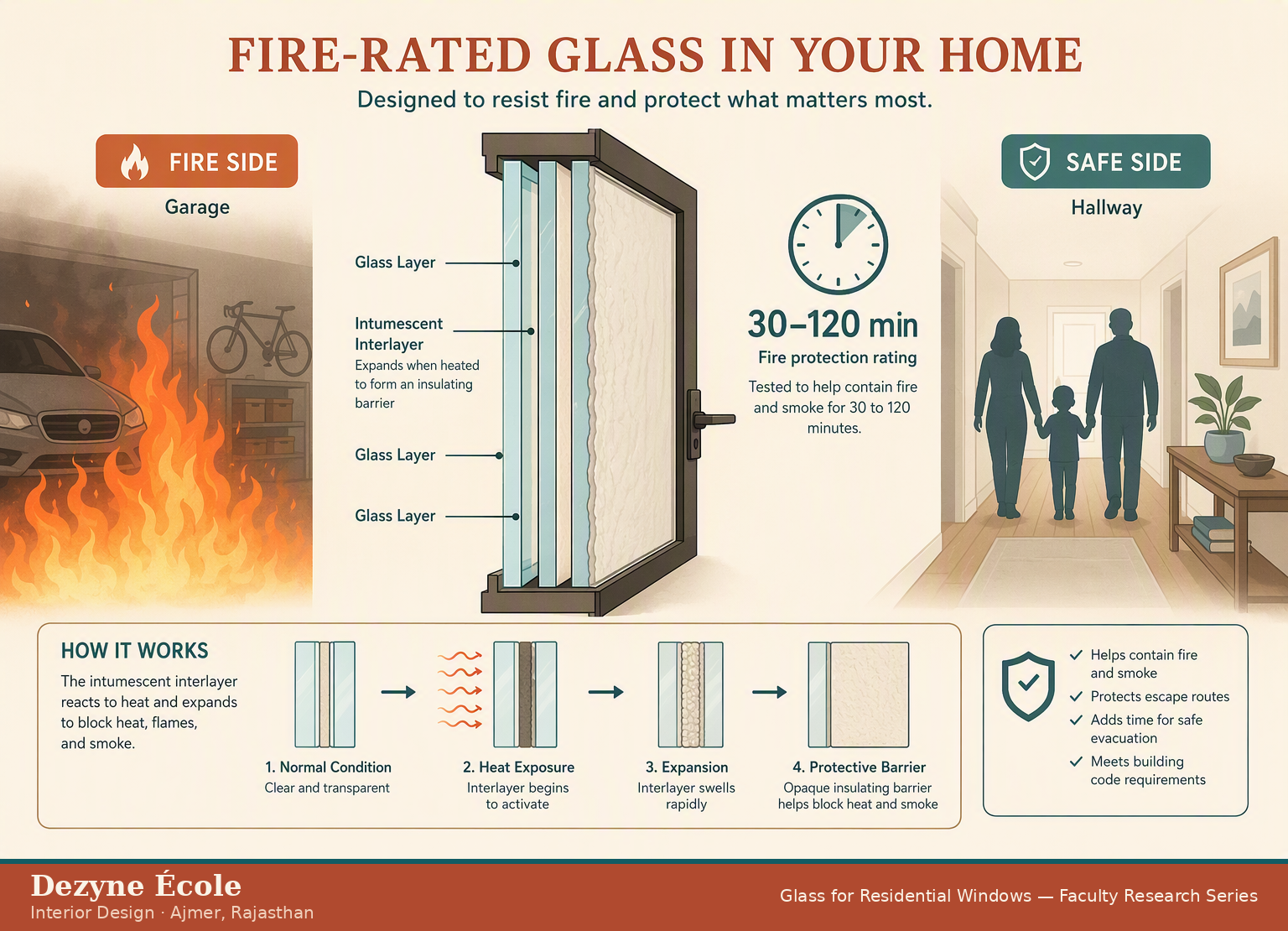 Fire-rated glass door diagram: intumescent interlayer protects hallway from garage fire, 30 to 120 minute rating
4.9
Bullet-Resistant Glass
Not a single product but a laminate
stack: multiple glass plies interleaved with thick PVB or ionoplast
interlayers, usually finished with a polycarbonate (spall-shield) inner face.
Rated by threat level (e.g., UL 752 levels, EN 1063 BR classes), from handguns
to rifles. In residences, it appears in high-risk geographies, panic rooms, and
ground-floor glazing for high-profile occupants. It is thick, heavy, and costly
— but for everyone else, standard laminated security glass (P2A–P5A /
forced-entry rated) offers realistic burglary resistance at a fraction of
the price and weight.
4.10
Wired Glass
Glass with a steel mesh cast inside,
historically sold as "fire glass" and "safety glass." Both
claims are now qualified: it holds together in fire (integrity only) but is weaker
under impact and breaks into dangerous shards. Many jurisdictions restrict
it; where it is used, apply safety film or choose modern clear fire-rated glass
instead.
4.11
Smart (Switchable) Glass
- PDLC (polymer-dispersed liquid crystal): Turns from translucent to transparent at the flick of a switch (e.g., AIS Swytchglas) — instant privacy for bedrooms, bathrooms, and partitions, with light still passing in the "private" state.
- Electrochromic glass: Tints gradually and electronically in response to sun or controls (e.g., SageGlass), dynamically managing glare and heat without blinds — the leading edge of new-age facade design.
- Suspended-particle (SPD): Variable tint from clear to very dark, popular for skylights and glare-critical rooms.
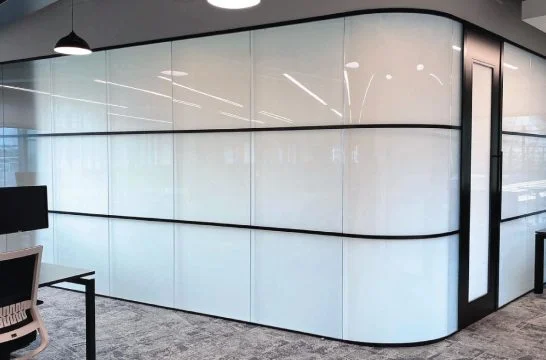 Switchable glass in opaque/privacy mode (546×360 px) — shows the "frosted at a switch" concept in a real interior.
4.12
Self-Cleaning Glass
A dual-action exterior coating
(e.g., Pilkington Activ, Saint-Gobain Bioclean): a photocatalytic layer
uses UV to break down organic dirt, and a hydrophilic surface lets rain
sheet off evenly, washing residue away without spots. In dusty, water-scarce
regions like Rajasthan, it meaningfully reduces maintenance — though occasional
rinsing is still needed in long dry spells.
4.13
Decorative & Privacy Glass
- Frosted/etched/sandblasted and acid-etched glass: diffuse light, permanent privacy (bathrooms, sidelights, partitions).
- Lacquered (back-painted) glass: opaque colour coating for wall panels, wardrobe shutters, kitchen cabinetry and splashbacks — vibrant, humidity-proof, easy to wipe (keep it away from direct flame and sustained heat above ~65°C).
- Textured/patterned and reeded glass: privacy with sparkle and shadow play; the current darling of interior designers for fluted partitions and shower screens
- Mirror and one-way observation glass: careful — one-way effects depend on light imbalance and reverse at night.
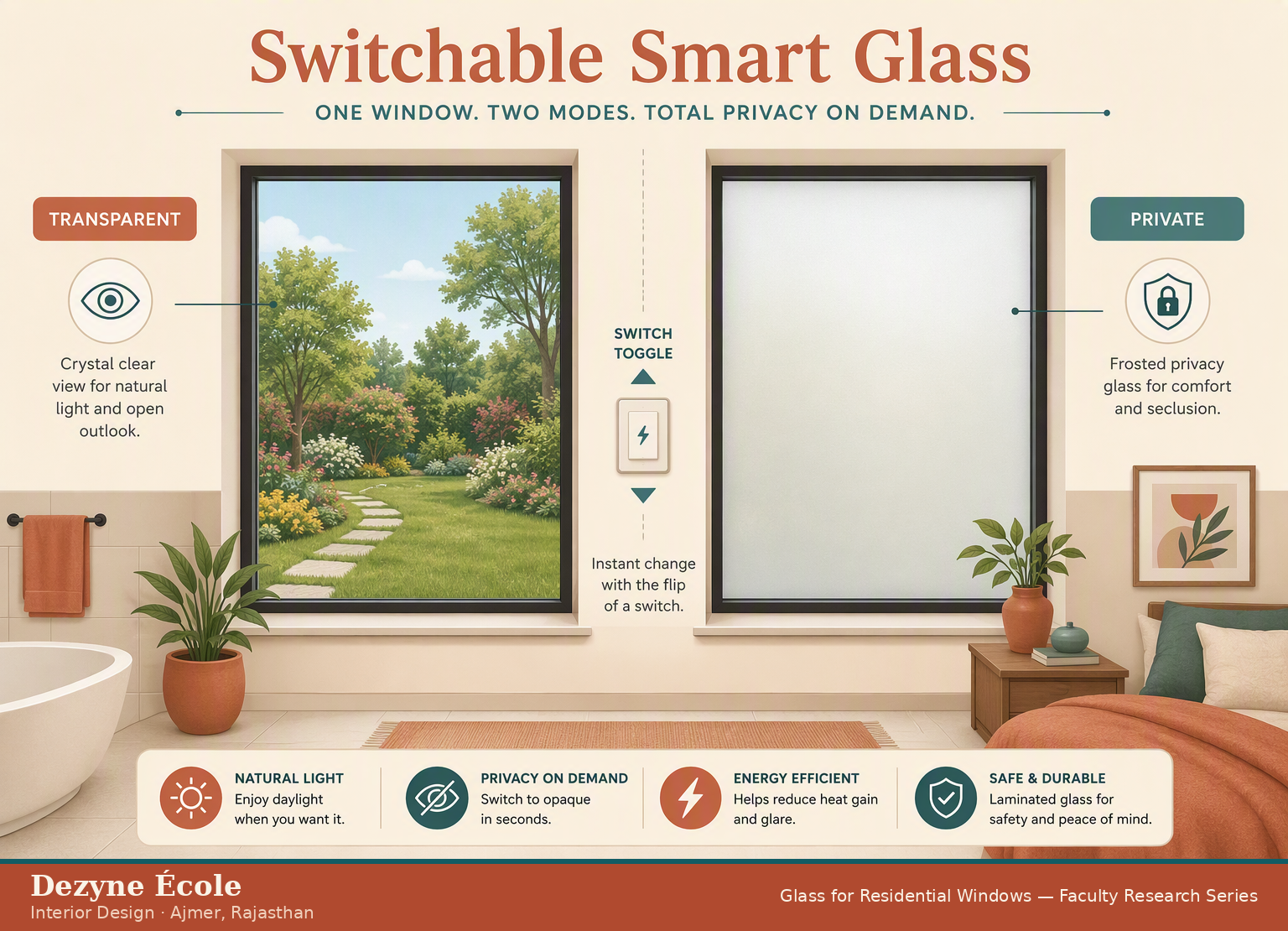 Switchable smart glass window: transparent to frosted privacy mode at the flip of a switch
5.
Safety and Security: Non-Negotiables for a Home
5.1
Where safety glass is mandatory (harmonised global practice — verify local
codes: NBC India, IBC, EN 12600, ANSI Z97.1)
- All glazing in doors and side panels within ~600 mm of doors
- Low-level glazing with sill below ~500–800 mm from floor
- Bathrooms, shower screens, and wet areas
- Staircases, landings, balustrades, and floor-to-ceiling windows
- Overhead glazing (skylights, canopies) — use laminated so broken glass stays in place
- Large panes where human impact is foreseeable
5.2
The safety hierarchy
- Tempered: resists impact, breaks safely — minimum for doors and wet areas.
- Laminated: holds together after breakage — best for overhead, railings, and child zones.
- Tempered-laminated: both — specify for structural, overhead, and frameless work.
- Security laminates (thicker/multiple interlayers): forced-entry resistance for ground floors.
5.3
Security beyond the glass
- Ground-floor and accessible windows: laminated inner lite at minimum; a burglar with a hammer defeats annealed or tempered glass in seconds, but laminated glass keeps them working noisily for minutes.
- Multi-point locking hardware, laminated glass in door sidelights, and considered sightlines matter as much as the glass itself.
- In storm-prone or seismic regions, ask for tested impact/cyclic-load-rated assemblies.
5.4
Thermal-stress safety in hot climates
A pane partly in sun and partly in
shade can crack from differential expansion ("thermal breakage").
Risk rises with tinted, reflective, or Low-E glass, big panes, deep external
shadows, and desert diurnal swings of 20°C+. Mitigation: heat-strengthen or
temper solar-absorbing glass, ensure clean edge work, avoid shading patterns
that cut sharp lines across a pane, and follow the manufacturer's
thermal-stress assessment for any coated glass. And a myth worth killing:
"heat-resistant" glass is neither unbreakable nor immune to thermal
shock — always allow expansion gaps and follow installation guidelines.
6.
Acoustics: Designing for Homes Near Roads and Noise
Windows are the weakest acoustic
element of the facade — upgrading walls while leaving thin glazing is
pointless. How sound gets through: the glass vibrates like a drum skin and
re-radiates noise inside. You defeat it with mass, damping, asymmetry, and
depth of airspace.
6.1
The four levers
- Mass: thicker glass blocks more sound (mass law — each doubling of mass adds ~6 dB). 10–12 mm outperforms 4 mm.
- Damping (lamination): a PVB interlayer converts vibration to heat; acoustic PVB interlayers (softer, engineered) add roughly 3–5 dB over standard PVB and kill the "coincidence dip" where thin glass suddenly transmits sound at certain frequencies.
- Asymmetry: two panes of different thickness (e.g., 6 mm + 10 mm) resonate at different frequencies, so there is no single weak frequency.
- Cavity depth: wider air gaps insulate better acoustically — thermally optimal 12–16 mm is acoustically mediocre; 30–100 mm gaps (secondary glazing, or "acoustic" DGUs with wide cavities) perform dramatically better. Note the tension: heat efficiency wants ≤16 mm, acoustics wants more.
6.2
What typical builds achieve (indicative)
| Build-up | Approx. STC / Rw |
| Single 6 mm monolithic | ~31 |
| Standard DGU (4-12-4) | ~30–33 (little better than single — resonance) |
| DGU with one 6.38 mm laminated lite | ~35–38 |
| DGU, asymmetric, with acoustic-PVB laminate | ~40–44 |
| Laminated DGU + secondary window (wide gap) | 45–50+ |
6.3
Practical rules for a house near a busy road
- Target Rw + Ctr ≥ 40 dB on the noise-facing facade (that is the traffic-corrected rating — a plain Rw can flatter the glass by 4–6 dB).
- Specify asymmetric laminated DGU with acoustic PVB (e.g., 6 mm outer / 12–16 mm cavity / 8.38 mm acoustic-laminated inner).
- Seal the perimeter obsessively: a 1% unsealed gap can waste 10+ dB. Use compression-seal casement or tilt-turn systems rather than sliding windows on noisy faces — sliders leak sound through their tracks.
- Bedrooms away from the road can use a lower spec; put bathrooms and stairwells on the noisy side as buffers where the plan allows.
- Frames and installation are part of the system: heavy, well-gasketed frames; acoustic sealant at the wall junction; no trickle vents on the noise face (or use acoustic-rated vents).
7.
Climate Playbook I — Hot & Dry: Designing for Rajasthan (45–50°C)
Cities like Jodhpur, Jaisalmer,
Barmer, Bikaner, and Jaipur face searing summers, intense solar radiation, large
diurnal temperature swings, dust storms, and water scarcity. The strategy: block
the sun's heat, keep the daylight, insulate against the conducted heat, survive
the dust
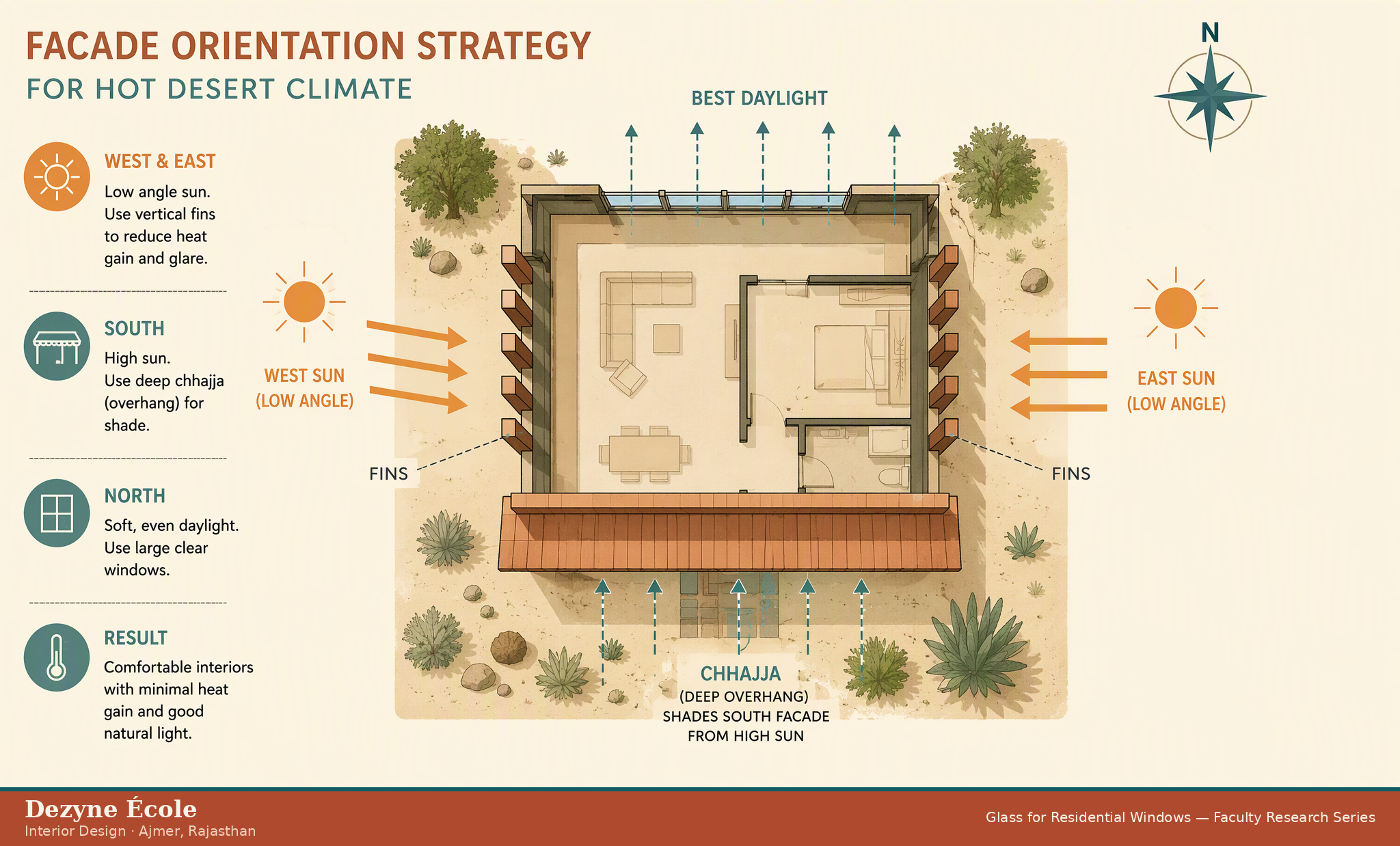 Facade orientation strategy for hot desert climate homes: west east fins, south chhajja shading, north daylight — Dezyne École
7.1
Specification priorities
- Low SHGC is king. Target ≤ 0.25–0.35. ECBC 2017 caps non-north fenestration at SHGC 0.27 and U-factor 3.0 W/m²·K for hot-and-dry zones — treat these as the floor, not the ceiling.
- Solar-control Low-E, spectrally selective: SHGC ~0.23–0.28 with VLT ~50–65% gives cool interiors without cave-like darkness. Prefer this over dark tints or mirror reflective glass for living spaces.
- Double glazing with argon to resist conducted heat (the desert air itself is 45°C+; even radiatively perfect glass conducts). U ≤ 1.8–2.0 W/m²·K is a sensible residential target. Don't neglect the frame: thermally broken aluminium or uPVC — a dark, non-broken aluminium frame in desert sun is itself a heat source.
- Orientation & shading beat any glass. Put main glazing on north and south with deep overhangs, verandahs, chhajjas, jali screens, and vertical fins on east and especially west — the low, brutal afternoon sun. ECBC even grants SHGC credit for permanent external shading. Fixed external shading + moderate-performance glass usually outperforms ultra-performance glass with no shading.
- Thermal-stress engineering: heat-strengthen or temper coated/tinted panes; avoid partial shading lines; respect edge quality and expansion clearances.
- Dust & maintenance: self-cleaning coated glass, smooth (non-textured) exterior faces, accessible tilt-in or casement designs for washing, and consider hydrophobic add-on coatings where borewell water is hard (hard-water spots etch glass permanently if ignored).
- Daylighting balance: VLT 40–60% keeps rooms bright without glare; use lighter interior finishes to bounce diffuse light deep inside.
- Winter nights are cold (desert dips to 2–8°C): the same DGU + Low-E assembly that blocks summer heat retains winter warmth — another reason to choose solar-control Low-E rather than plain tinted glass.
7.2
A sample Rajasthan villa glazing schedule (indicative starting point — finalise
with your fabricator's performance data)
| Location | Build-up (outboard → inboard) | Target SHGC | Target VLT | Notes |
| West façade windows | 6 mm solar-control Low-E / 12 Ar / 6 mm clear | ≤ 0.25 | 45–55% | Add vertical fins; the harshest exposure |
| South windows (shaded) | 6 mm solar-control Low-E / 12 Ar / 6 mm clear | ≤ 0.30 | 55–65% | Overhang/chhajja essential |
| North windows | 5 mm Low-E / 12 Ar / 5 mm clear | ≤ 0.35 | 60–70% | Best diffuse daylight — maximise |
| East bedrooms | 6 mm solar-control Low-E / 12 Ar / 8.38 acoustic PVB laminate | ≤ 0.28 | 50–60% | Morning sun + traffic damping |
| Road-facing living | 6 mm solar Low-E / 16 Ar / 10.76 acoustic laminate | ≤ 0.30 | 50–60% | Rw+Ctr ≥ 40; casement, not slider |
| Bathrooms | 5 mm obscure/frosted + clear DGU; tempered inner | — | — | Privacy + safety |
| Skylight / stairwell | 6 mm heat-strengthened solar Low-E / 12 Ar / 8.38 laminated | ≤ 0.25 | 40–50% | Laminated inner mandatory overhead |
| Ground-floor security | Laminated (P2A+) inner lite on all accessible openings | — | — | Forced-entry resistance |
| Courtyard/pooja/partitions | Lacquered or fluted glass, tempered | — | — | Colour and glow without see-through |
8.
Climate Playbook II — Cold & Snowy Regions
In heating-dominated climates
(alpine regions, northern Europe, Canada, Himalayan towns), the logic inverts:
- Insulate aggressively: double or triple glazing, argon/krypton fills, warm-edge spacers, thermally broken frames. Target whole-window U ≤ 1.0–1.4 W/m²·K (passive-house level ~0.8).
- Harvest the sun: equator-facing (south, in the northern hemisphere) glazing with higher SHGC (0.40–0.62) delivers free winter heating — ECBC allows 0.62 in cold zones, and energy authorities recommend high-SHGC south windows. Keep SHGC low on east/west.
- Low-E placement: coatings positioned to reflect indoor heat back into the room (surface 3 in a DGU).
- Condensation control: warm-edge spacers and good indoor humidity management prevent the moisture ring that rots timber sills; interior surface temperature is the metric to watch.
- Snow and structure: check design snow loads on skylights and glass roofs; use laminated inners overhead; ensure drainage details cope with melt-freeze cycles; specify IGU seals rated for large temperature differentials.
- Maximise VLT (70%+): winter daylight is scarce and precious; avoid tints entirely on the equator-facing side.
9.
Privacy Without Losing Light
- Switchable PDLC glass for bathrooms, bedrooms, and internal partitions — clear when you want connection, milky-private at the touch of a switch.
- Frosted/acid-etched bands at eye level on street-facing windows: full daylight, zero sightline.
- Reflective/one-way glass works only while the outside is brighter — at night it betrays you; pair with sheer curtains.
- Frit (ceramic-dot) patterns graduated across the pane: solar control + privacy + a designed aesthetic.
- Landscaping and screens: jaali, louvres, pergolas, and planting remain the cheapest privacy technology ever invented — and they shade the glass too.
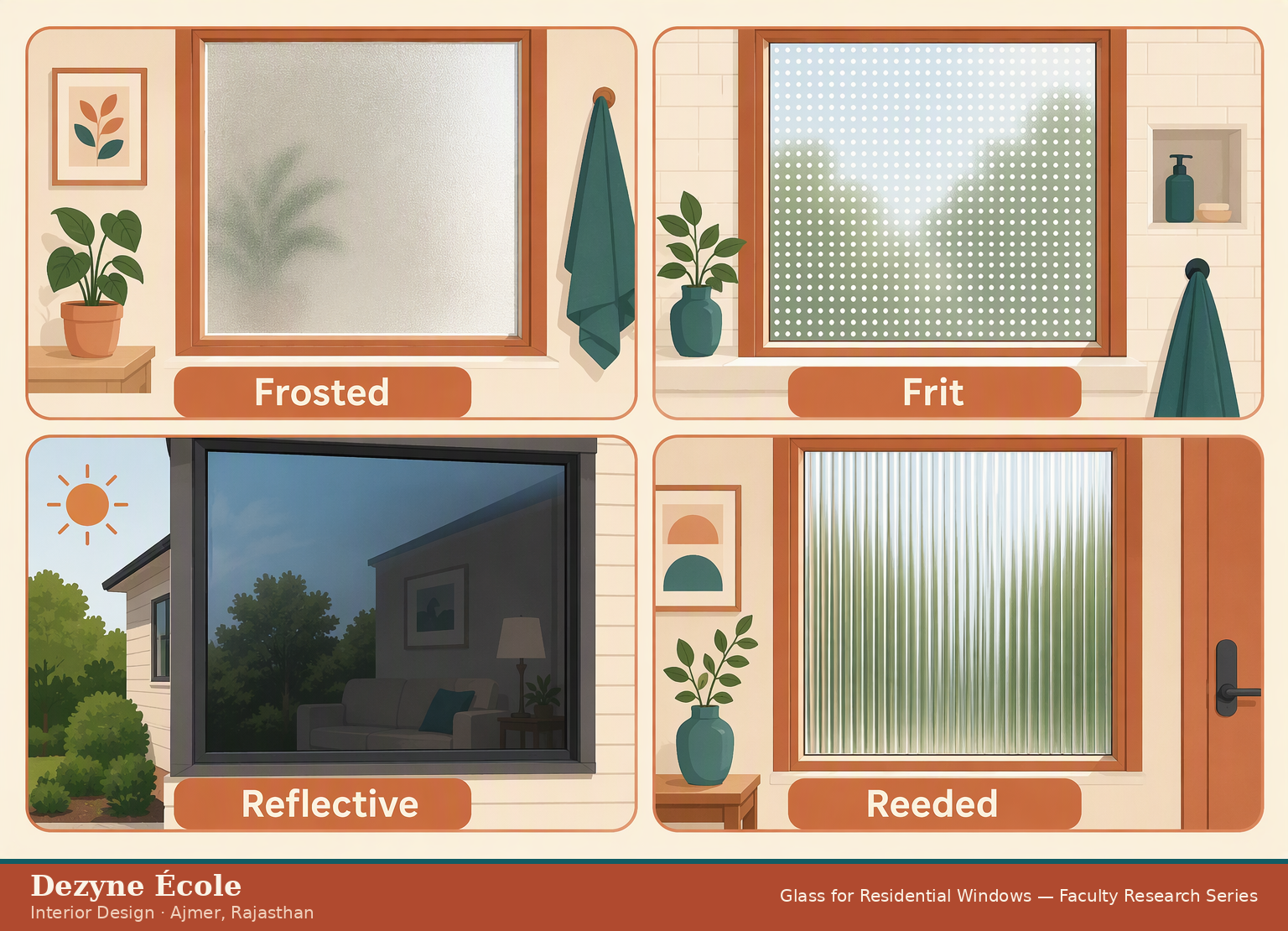 Four privacy glass options compared: frosted, ceramic frit, reflective and reeded glass
10.
Maintenance: Keeping Glass Performing for Decades
- Routine cleaning: soft cloth or squeegee, lukewarm water with mild detergent; never abrasive pads or ammonia/acid-based cleaners on coated, lacquered, or decorative faces; dry the edges after washing.
- Hard-water spots (critical in Rajasthan): borewell/groundwater minerals permanently etch glass — wipe spray off promptly, fit deflectors on sprinklers, use hydrophobic coatings, and treat early staining with manufacturer-approved cerium-oxide polishing.
- Seals and drainage: inspect DGU perimeter seals, weep holes, and gaskets annually; fogging between panes means seal failure — the unit needs replacement, and warranty claims are usually honoured for 5–10 years, so keep documentation.
- Storage & handling on site: store glass vertically in dry, ventilated areas on rubber/button spacers; never flat-stacked, never outdoors unprotected, painted/coated side protected; clean gloves only.
- Post-installation protection: plaster, weld spatter, and paint ruin glass during finishing works — mask every pane before other trades begin.
- Self-cleaning glass reduces but does not eliminate maintenance, especially in long dry, dusty seasons.
11.
Myths That Cost Money
- "All glass is heat-resistant." False — ordinary glass cracks under thermal stress; heat-resistant behaviour comes from borosilicate, ceramic, or toughened compositions.
- "Toughened glass is unbreakable / heat-proof." It is stronger and safer, not indestructible; thermal shock and edge damage still break it.
- "Thicker glass = quieter room." Not alone — two equal panes resonate together; damping (lamination), asymmetry, and cavity depth matter more than raw thickness.
- "Double glazing automatically means soundproof." A standard thermal DGU barely outperforms single glass acoustically; acoustic performance needs the specific build-ups in Section 6.
- "Dark tinted glass keeps the house coolest." It absorbs heat and re-radiates inward while darkening rooms; spectrally selective solar-control glass blocks more heat with more light.
- "Any glass can be made heat-resistant at home." Never — coatings and DIY treatments cannot replicate factory heat treatment; buy certified processed glass from reputable manufacturers.
- "U-factor doesn't matter in hot climates." Conducted heat through glass and frames is a major cooling load in the desert — high-performance frames and warm-edge spacers pay off in every climate.
12.
The 10-Step Selection Checklist (Pin This on the Studio Wall)
- Fix your climate strategy first: hot → low SHGC; cold → low U + high south SHGC; mixed → orientation-specific specs.
- Set numeric targets for VLT, U-factor, SHGC per façade — before falling in love with any product brochure.
- Choose the configuration: single (rarely), DGU (default), triple (cold/extreme acoustic).
- Layer the coatings: solar-control Low-E in hot zones; insulating Low-E in cold zones; always inside the sealed unit.
- Resolve safety: tempered or laminated wherever codes and common sense demand; laminated overhead; HST for critical toughened panes.
- Resolve security: laminated inner lite on all accessible openings; escalate to security-rated laminates by risk.
- Engineer acoustics: Rw+Ctr targets for noise-facing façades; asymmetric acoustic-laminated DGUs; compression-seal frames; airtight installation.
- Design shading and orientation — chhajjas, fins, verandahs — no coating can rescue an unshaded west wall.
- Plan maintenance: self-cleaning glass, hard-water strategy, washing access, seal inspection schedule.
- Demand certified data: whole-window U-values, tested SHGC/VLT, acoustic test reports (Rw/STC/OITC), safety-glazing compliance marks, and IGU warranty — not marketing claims.
13.
Glossary
- VLT (Visible Light Transmittance): % of daylight passing through glass.
- U-Factor / U-Value: rate of conductive heat transfer; lower is better.
- SHGC (Solar Heat Gain Coefficient): fraction of solar heat admitted; lower is cooler.
- Low-E: low-emissivity coating that reflects radiant heat.
- DGU / IGU: double/insulated glazing unit — sealed cavity between panes.
- PVB / Acoustic PVB: interlayer bonding laminated glass; acoustic grade damps sound.
- Tempered / Toughened: heat-treated safety glass, 4–5× stronger, granular break.
- Laminated: glass + interlayer sandwich; holds together when broken.
- STC / Rw / OITC / Rw+Ctr: sound-insulation ratings (interior sources / general / exterior sources / traffic-corrected).
- Warm-edge spacer: insulating spacer reducing edge heat loss and condensation.
- Spectrally selective: coatings admitting light while rejecting heat (high VLT : SHGC ratio).
- HST (Heat-Soak Test): destructive-risk screening that removes nickel-sulphide-prone tempered panes.
- WWR (Window-to-Wall Ratio): share of façade in glass — cap near 40% in hot climates for energy sanity.
Frequently Asked Questions (FAQs)
Which glass is best for house windows in hot climates like Rajasthan?
The best glass for hot climates is solar-control Low-E glass in a double-glazed unit (DGU). Look for SHGC ≤ 0.25–0.35 (it blocks 65–75% of the sun's heat), VLT of 45–60% (rooms stay bright), and a whole-window U-value under 2.0 W/m²·K with argon fill and a thermally broken frame. This combination keeps interiors dramatically cooler without making rooms dark, and cuts air-conditioning loads substantially in 45–50°C summers.
What is the difference between tempered glass and laminated glass?
Both are safety glasses, but they fail differently. Tempered glass is heat-treated to be 4–5 times stronger than ordinary glass and crumbles into small, blunt granules when broken — ideal for doors, bathrooms, and low windows. Laminated glass bonds two panes with a PVB interlayer; when cracked, the fragments stick to the film and the pane stays in the frame — ideal for skylights, railings, security glazing, and sound insulation. For maximum protection (overhead or structural glass), specify tempered-laminated glass.
What is a good SHGC value for windows?
SHGC (Solar Heat Gain Coefficient) measures how much solar heat passes through glass, from 0 to 1. In hot, cooling-dominated climates (Rajasthan, Middle East, tropical zones), choose SHGC 0.25–0.35. In cold, heating-dominated climates, a higher SHGC (0.40–0.62) on equator-facing windows provides free winter heating, while east and west windows should stay low. India's ECBC 2017 caps fenestration SHGC at 0.27 for hot-and-dry climate zones.
How do I reduce traffic noise through my windows?
Use asymmetric laminated double glazing with an acoustic PVB interlayer — for example, a 6 mm outer pane, 12–16 mm argon cavity, and an 8.38 mm acoustic-laminated inner pane. Target Rw + Ctr ≥ 40 dB (the traffic-corrected sound rating). Equally important: choose casement or tilt-turn windows with compression seals instead of sliding windows, and seal every perimeter gap — a 1% unsealed opening can waste over 10 dB of performance.
Is double glazing enough for soundproofing?
Not on its own. A standard thermal double-glazed unit (two 4 mm panes, 12 mm air gap) achieves only about STC 30–33 — barely better than a single pane, because the two equal panes resonate together. Real acoustic performance comes from different pane thicknesses, laminated glass with acoustic PVB, and wider air cavities. A well-built acoustic DGU reaches STC 40–44; adding a secondary window with a 50–100 mm gap can exceed STC 45–50.
What is Low-E glass and do I need it?
Low-E (low-emissivity) glass has an invisible metallic coating that reflects radiant heat while admitting daylight. In hot climates it keeps solar heat out; in cold climates it keeps indoor heat in. It also blocks most UV radiation, protecting your skin and preventing furniture, art, and flooring from fading. For any air-conditioned or heated home, yes — Low-E is one of the highest-value upgrades you can specify, typically paying back through energy savings.
Where is safety glass mandatory in a home?
Safety glass (tempered or laminated) is required in and around doors, low-level windows, bathrooms and shower screens, staircases and balustrades, floor-to-ceiling glazing, and all overhead glass such as skylights and canopies (always laminated overhead, so fragments cannot fall). This is consistent across NBC India, IBC, EN 12600, and ANSI Z97.1 — but always verify against your local building code.
Which glass gives privacy without blocking daylight?
Several options preserve light while screening views: frosted or acid-etched glass (permanent privacy, diffused light), switchable smart glass/PDLC (clear to translucent at a switch), ceramic frit patterns (graduated privacy with solar control), and reflective glass (daytime privacy only — the effect reverses at night, so pair it with blinds). For bathrooms and street-facing windows, frosted bands at eye level are the most cost-effective solution.
How often should window glass and seals be maintained in dusty regions?
In dusty, water-scarce regions like Rajasthan, clean exterior glass monthly with a soft cloth, lukewarm water, and mild detergent — never abrasive or ammonia-based cleaners on coated glass. Wipe off borewell or sprinkler water immediately; hard-water minerals permanently etch glass. Inspect DGU seals, gaskets, and weep holes once a year — fogging between panes means seal failure and the unit needs replacement (usually covered by a 5–10 year IGU warranty). Self-cleaning coated glass reduces, but does not eliminate, this routine.
Can ordinary glass be made heat-resistant at home?
No. Heat-resistant behaviour comes from the factory manufacturing process — borosilicate compositions, ceramic glass, or controlled thermal toughening. No DIY coating or home treatment can replicate it, and attempting it is unsafe. Always buy certified processed glass from a reputable manufacturer, and follow installation guidelines with proper expansion gaps, since even heat-resistant glass can crack under sudden thermal shock.
About the Writer
Dr. Vinita Mathur Founder President & Principal, Dezyne École College (est. 2008), Ajmer is ,one of India's leading design institutions for interior and spatial design education. A government-recognized institution she established in 2008 to bridge classroom learning with real-world design, management, and technology education. With years of experience teaching material science, climate-responsive design, and building technology to future architects and interior designers, she specializes in translating complex building-performance concepts into practical, buildable knowledge. This guide is part of Dezyne École's Faculty Research Series, created to give design professionals and homeowners worldwide a reliable, climate-aware reference for selecting glass in residential spaces.
Compiled from the technical literature and product guidance of AIS (Asahi India Glass), Saint-Gobain, Guardian Glass, Pilkington/NSG, Vitro/PPG, and Cardinal, together with India's Energy Conservation Building Code (ECBC 2017) and international window-rating practice. Always verify final specifications against local codes and the manufacturer's current performance data for the exact build-up you intend to use.